
Master the legal strategies for Cheque bounce cases with expert insight:
In the modern commercial world, a cheque is a promise of payment. When that promise is broken due to “insufficient funds” or “account closed,” it isn’t just a financial setback—it is a legal offense. Under Section 138 of the Negotiable Instruments Act, the law provides a stringent mechanism to recover your money and penalize the defaulter.
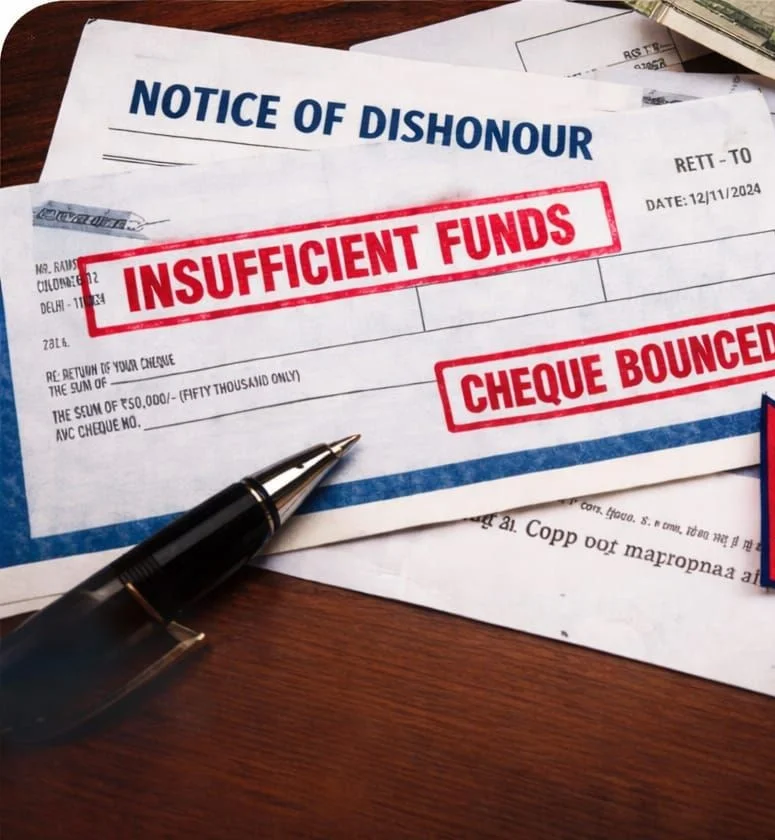
However, many people lose their right to recover funds because they miss the strict legal timelines required by the courts
1. The 30-Day Mandatory Notice
The moment you receive a “Cheque Return Memo” from your bank, the clock starts ticking. You must send a formal Legal Notice to the drawer within 30 days of receiving that memo. This notice gives the defaulter 15 days to make the payment. If you miss this 30-day window to send the notice, the special criminal provisions of Section 138 may no longer apply to your case.
2. Criminal vs. Civil Liability
A common misconception is that a cheque bounce is only a civil matter. In reality, Section 138 makes it a criminal offense, punishable by imprisonment for up to two years, a fine which may extend to twice the amount of the cheque, or both. At K.D. Law Associates, we often recommend filing a simultaneous Civil Suit for Recovery to ensure maximum pressure and multiple avenues for reclaiming your funds.
3. “Interim Compensation” for the Complainant
Under recent amendments (Section 143A), the Court now has the power to order the drawer of the cheque to pay Interim Compensation to the complainant. This amount can be up to 20% of the cheque value and is usually ordered during the trial. This provides immediate partial relief to the victim even before the final judgment is passed.
4. Jurisdiction: Where to File?
Following the 2015 amendment, the rules for where to file a case became very clear. The case must be filed in the court within whose local jurisdiction the branch of the bank where the payee maintains the account is situated. If you deposit a cheque in your Guwahati branch and it bounces, the Gauhati courts will have the jurisdiction to hear your plea.
5. Why a Strategic Approach Wins
Success in NI Act cases depends on the “Service of Notice” and the “Presumption of Liability.” Since the law presumes that the cheque was issued for a discharge of debt, the burden of proof is often on the accused to prove otherwise. With over a decade of experience in financial litigation, Advocate Biplop Konwar ensures that every technicality—from the demand notice to the trial evidence—is handled with surgical precision.
6. The Statutory Presumptions
Under Section 118 and Section 139 of the NI Act, the court begins with a mandatory presumption that every negotiable instrument was made or drawn for “consideration” and that the holder of the cheque received it for the discharge of a debt or liability.
- Section 118: Presumes that the cheque was issued for consideration and on the date it bears.
- Section 139: Presumes that the holder of the cheque received it for the discharge, in whole or in part, of any debt or other liability.
- Section 149: Relates to the delivery of the instrument, reinforcing the validity of the transaction.
To rebut the statutory presumptions under the Negotiable Instruments (NI) Act, an accused must strategically dismantle the legal assumption that a cheque was issued for a specific debt. Under Section 138, the law starts with a heavy bias in favor of the complainant, but this can be overcome by establishing a “probable defense.”
7. The Standard of Proof: Preponderance of Probabilities
The accused is not required to prove their innocence “beyond a reasonable doubt,” which is the standard for the prosecution. Instead, the accused must only prove their defense on a preponderance of probabilities. This means you must show that your version of the facts is more likely to be true than the complainant’s version.
8. Strategic Avenues for Rebuttal
Rebutting the burden of proof typically involves one or more of the following strategies:
- Challenging “Legally Enforceable Debt”: The presumption under Section 139 only applies if there is a legally enforceable debt. If you can show the money was given for an illegal purpose, as a gift, or that the debt is time-barred by the Statute of Limitations, the case falls apart.
- The “Security Cheque” Defense: You must demonstrate that the cheque was handed over as a security measure for a different transaction—often a smaller loan—and not as a direct payment for the amount claimed. If you can provide evidence that the original liability was settled, the continued retention of the cheque by the complainant is deemed a misuse of trust.
- Questioning Financial Capacity: A powerful way to rebut the presumption is to challenge the complainant’s “standing.” If the complainant cannot prove they had the financial means to lend a large sum of money (e.g., failing to show the source of funds or not declaring the loan in Income Tax Returns), the court may find the debt improbable.
9. Using Procedural Tools: Section 311 Cr.PC (Section 348 BNSS)
To establish a probable defense, the accused may need to bring in evidence that was not initially on record.
- Essentiality of Evidence: The court has the power to summon any person as a witness if their evidence appears essential to the “just decision” of the case.
- Proving a Pattern of Misuse: If you can show that the complainant has used similar cheques to threaten others or has a history of claiming inflated amounts, this evidence helps displace the initial presumption of liability.
- Stage of Trial: This power is not constrained by the closure of evidence; it can be invoked even at the final argument stage if it assists the court in finding the “truth of the matter.”
10. Direct vs. Circumstantial Evidence
You do not always need to lead direct evidence (like a written receipt) to rebut the presumption. You can rely on:
- Cross-examination: Highlighting contradictions in the complainant’s testimony.
- Circumstantial Evidence: Pointing out the lack of a formal agreement or the improbable nature of the transaction based on the parties’ relationship.
Advocate’s Insight: The goal is to create a “reasonable doubt” in the mind of the Court. By successfully shifting the burden back to the complainant, they are then forced to prove the debt exists with much stricter evidence, often leading to an acquittal for the accused.
With regard

Great article! A cheque bounce case lawyer can help resolve financial disputes through proper legal action.